
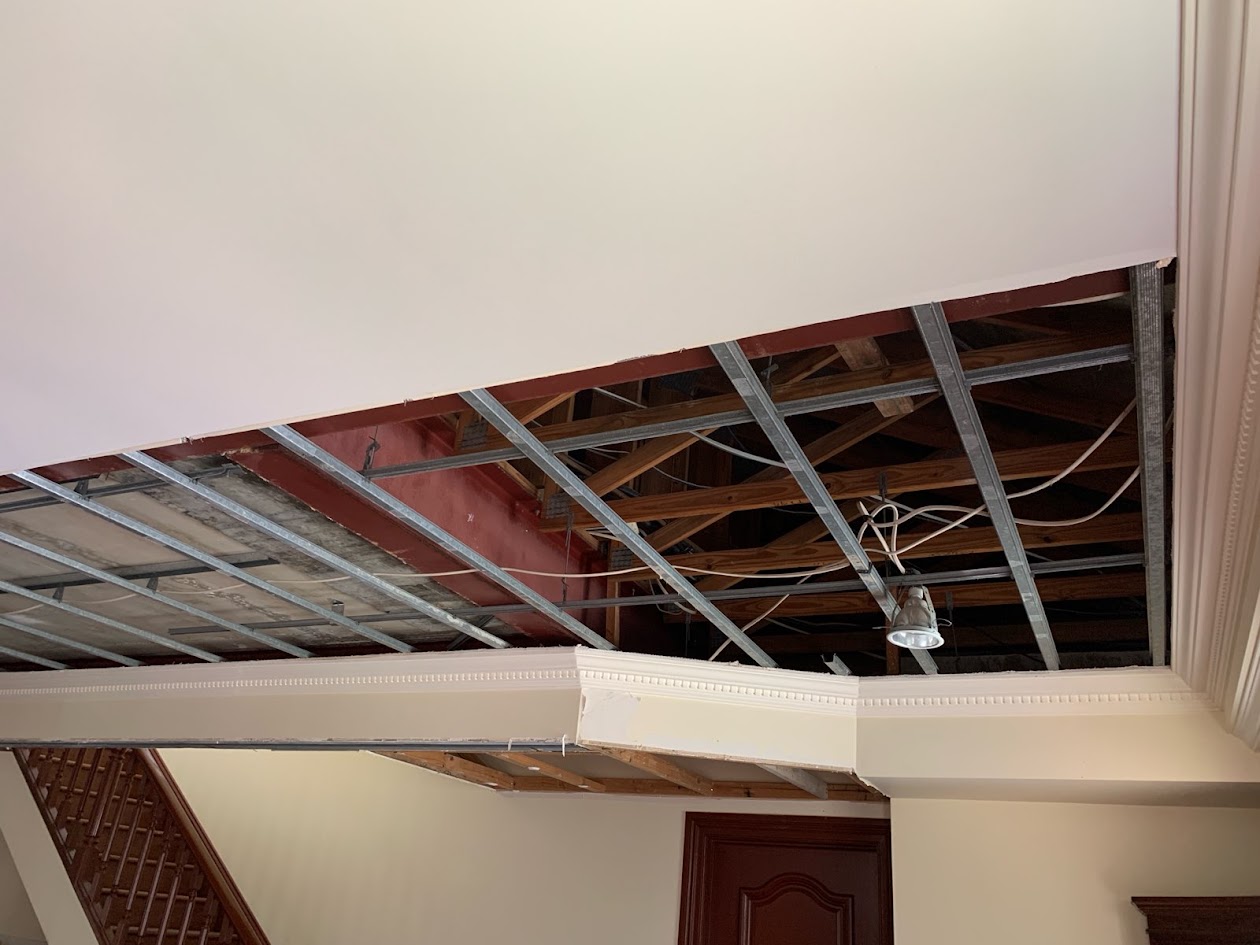
Once ceiling replacement is being considered, the next decision is its extent. For an Auchenflower room, replacing one affected section may preserve sound material, while replacing the entire ceiling can simplify continuity and access. The right boundary depends on the condition of what remains, not simply a preference for doing either the least or the most work.
Queensland Interior Linings can discuss ceiling replacement within a Brisbane plastering scope. Start with an assessment of the lining, its support and the reason replacement is needed before comparing installation options.
Confirm what replacement needs to solve
Widespread damage, uncertain attachment, repeated alterations or a planned redesign can each lead to replacement, but they imply different work. New sheets will not solve a leak, unsuitable framing or ongoing movement. Those conditions need their own assessment and remedy before the new lining is installed.
If the ceiling is sagging or appears unstable, keep the affected area clear and obtain appropriate advice rather than attempting exploratory removal. Older ceiling materials may require asbestos assessment before disturbance. These checks belong before demolition planning and should be acknowledged in the scope.
Compare partial replacement on its merits
Replacing a defined section retains unaffected lining and can reduce removal and disposal. It may be suitable where damage is genuinely local and the adjoining ceiling is sound. The repair still needs appropriate edge support and a workable joint with the retained material.
The tradeoff is matching. Differences in board level, old surface texture or accumulated paint can make the transition more visible. A partial replacement may therefore require broader joint finishing and decoration than its board area suggests. Ask how those transitions will be managed under the room's normal light.
Understand what whole-room replacement adds
A new ceiling across the room gives a more consistent lining surface and can allow coordinated service changes while the cavity is accessible. It may avoid several isolated transitions. However, it affects a larger area and may require more extensive treatment at cornices, access openings and fittings.
Whole-room replacement does not automatically require replacing every decorative detail. Some junctions may be retained if their condition and the installation method allow it, while others may be disturbed. Have that distinction written down rather than assuming all perimeter features can remain untouched.
The residential plastering service is a starting point for discussing the ceiling alongside adjacent wall and trim work.
Coordinate the open-ceiling stage
If lighting or other services are changing, agree their positions and responsibilities before closure. Qualified electrical trades must carry out electrical work. Required insulation, service clearances and any inspections should also be resolved while access is available.
Manufacturer guidance and the project specification should determine board type, support, fixing and jointing. Do not accept a single generic fastening rule as a substitute for a suitable installation method. If the ceiling forms part of a fire or acoustic system, its complete specified assembly must be followed.
Compare the final room, not just new sheets
For ceiling replacement in Auchenflower, ask each option to identify protection, removal, disposal, support repairs, lining, cornice work and the painting boundary. Drying and sanding stages also affect when the room can be handed back; wet compound must not be sanded to force an earlier finish.
Give Queensland Interior Linings room photographs, ceiling dimensions and details of planned service changes through the quote enquiry. A well-defined comparison explains what partial replacement would retain, what whole-room replacement would improve and which uncertainties require inspection before the final extent is approved.