
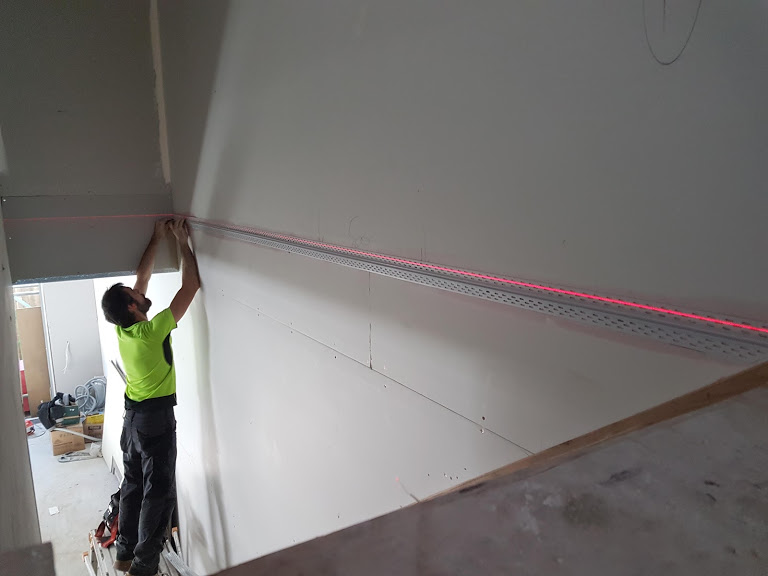
Setting and sanding can sound like a final tidy-up, yet the expected finish should be decided before the last coat of compound. For a Bardon renovation, standard joint treatment may be suitable for one surface while another needs a discussion about broader preparation. The important distinction is between finishing joints correctly and trying to correct the whole wall through sanding.
Queensland Interior Linings can discuss the finishing stage within a Brisbane plastering scope. Begin with the condition of the board, its alignment and the way light will fall across the completed room.
Check what finishing can realistically correct
Joint treatment covers and blends the joins, fastener locations and relevant details of a lining system. It is not a reliable remedy for badly aligned framing, loose sheets or significant movement. Sanding cannot flatten an underlying construction problem without risking damage to the lining surface.
Before accepting a finishing-only scope, ask whether the substrate is ready. Existing painted surfaces may also contain ridges, texture or old repair edges that need a separate preparation decision. If older materials will be disturbed, consider whether asbestos assessment is required before sanding or scraping begins.
Compare joint finishing with wider preparation
A conventional joint-finishing scope concentrates on seams, corners and fastener areas in accordance with the relevant system. It can be proportionate where the board face is sound and the intended lighting and decoration are compatible with the specified finish.
Wider preparation may be considered where multiple repairs, surface variation or critical lighting make the standard transition between treated joints and board face less suitable. Discuss the relevant level of finish and method rather than requesting “extra sanding” as a substitute. More sanding can damage the face paper or remove too much compound.
The tradeoff is additional work and drying stages. Ask what visible issue the broader treatment is expected to improve and what limitations remain in the retained substrate.
Respect product drying and recoating requirements
Compounds differ in how they set, dry and accept subsequent coats. Follow the selected manufacturer's guidance for application conditions, coat sequence and drying. A product becoming firm does not automatically mean it is ready for sanding or decoration.
Do not sand wet compound. A realistic programme allows the material to reach the required condition instead of using aggressive sanding or premature coating to force a deadline. Ventilation and site conditions should be managed appropriately without assuming every room dries at the same rate.
For the broader installation context, the plastering services page can help frame where setting and sanding fits within the complete lining job.
Review lighting and the painter's handover
For setting and sanding in Bardon, provide the intended paint sheen and lighting arrangement before the finish is agreed. Side lighting can reveal transitions that are less obvious under diffuse room light. Review expectations using representative conditions rather than an undefined demand for perfection under any possible beam.
Clarify who removes residual dust and applies the appropriate primer or sealer. The painter should know what substrate is being handed over and which products or preparation requirements are relevant. A plastering handover is distinct from a finished painted surface.
Compare defined outcomes, not coat counts alone
Ask Queensland Interior Linings to describe the surfaces included, treatment of existing defects, applicable finish expectations and sanding protection. Counts of coats alone do not explain whether different quotations cover the same work.
Use the quote enquiry to share full-surface photographs and the planned decoration. The best scope connects preparation, product requirements and visible expectations, with enough time for drying and a clear boundary between plaster finishing and painting.